

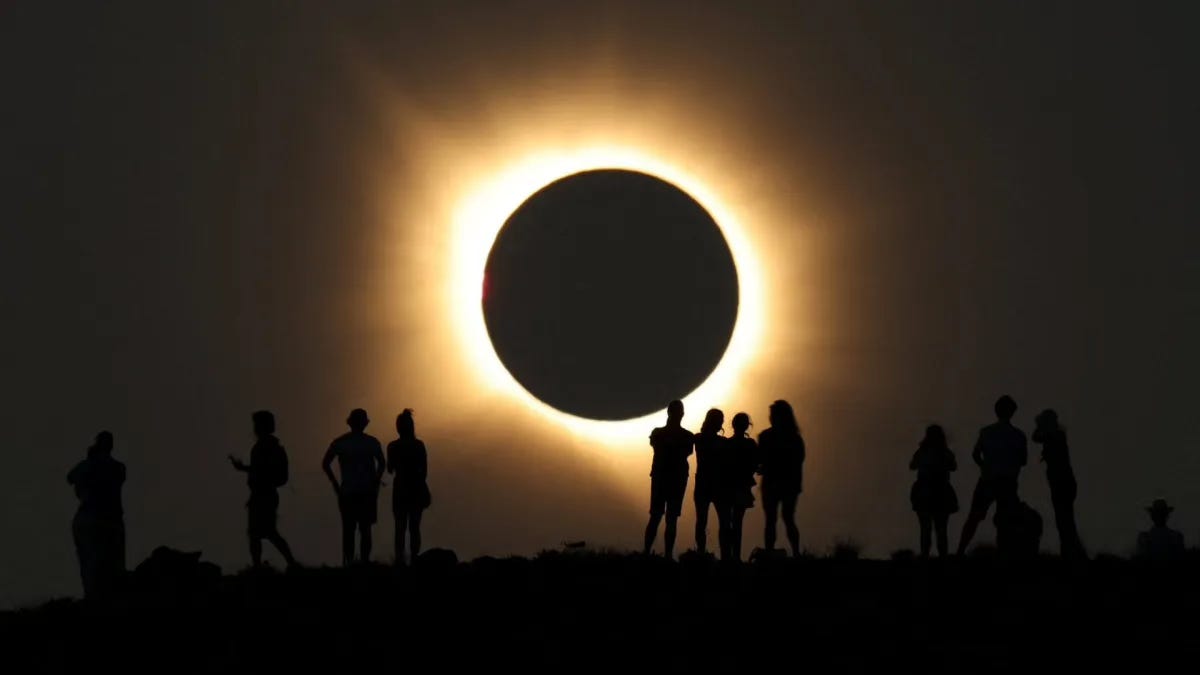
On Wednesday evening millions of people across the UK and Europe watched the Moon slide in front of the Sun in the most significant solar eclipse since 1999. In Britain, more than ninety per cent of the Sun disappeared behind it. In Iceland and Spain it vanished completely, and for a few minutes the sky did something skies are not supposed to do. It went dark in the middle of the day and the temperature dropped.
People wept and cheered. Others stood in silence, alone in a crowd of thousands, watching something none of them could control or explain or hurry along. Even the birds got confused and went quiet. Somewhere in that shared and helpless watching was a feeling most of us don’t have a name for anymore, even though for a few minutes it had all of us in its grip at once. There is a word for it though. Scientists call it awe.
Awe is what happens when we meet something too vast to fit inside our usual understanding of the world (a night sky, a mountain range, a total eclipse) and for a moment the mind stops trying to file it away and just lets it in. Psychologists describe it as a self transcendent emotion, one of the only ones we have that isn’t really about us at all. It doesn’t ask what’s in it for me. Instead it asks us to disappear a little so something larger can take our place.
Something measurable happens in the brain when this occurs. The default mode network (the part responsible for our inner monologue, the endless replaying and rehearsing of ourselves) goes quiet. At the same time the regions that process what we see and hear and feel light up. Dopamine rises, sharpening our attention. Oxytocin follows, softening us toward each other. The vagus nerve, the body’s great calming cable, gets a gentle pull. For a few minutes the noise of being yourself quiets down and what’s left in its place is something that pulls us into the present moment.
The psychologist Dacher Keltner, who has spent decades studying this emotion, calls what remains the “small self” — in his words, a kind of relief rather than a diminishment. A release from the exhausting work of being the main character. In his research, even a brief encounter with something vast (like a grove of towering trees or a wide open sky) has been enough to make people more generous, less anxious, less consumed by what they own or haven’t achieved. Awe it turns out feels good, and it also rearranges, however briefly, what we think matters.
And it rarely arrives alone. There is something different about the awe we feel together, standing shoulder to shoulder with strangers, all of us looking up at the same impossible thing. Shared awe has been shown to lower stress hormones and raise the ones that bind us to each other, until entire crowds begin to move and breathe in a kind of unspoken unison. It is the closest thing we have to synchronised feeling, which may explain why a hillside of strangers in Edinburgh cheered as one when the cloud finally cleared, and why a beach full of people who had never met each other fell silent at the exact same moment, for the same exact reason.
We don’t build much room for this anymore. Most of what fills our days is not designed to expand our field of vision but shrink it, whether it’s a phone screen, an inbox or a to do list that regenerates itself the instant it’s finished. We live most of the time at the scale of ourselves. Awe interrupts that. It’s a brief and involuntary reminder that we are small, and that smallness, done right, is a kind of liberating freedom.
I think one of the great problems of modern life, is that we’ve become less capable of noticing how incredible the world already is. There is something almost absurd about the fact that we need the Moon to pass in front of the Sun before millions of us stop and look at it. The Sun was spectacular the day before the eclipse. It will be spectacular tomorrow. A star roughly 93 million miles away is converting matter into energy and sending enough of it across the emptiness of space to warm your face. That happens every morning. And because it happens every morning we call it and see it as ordinary. We have become accustomed to the miracle.
Children though haven’t learned to do this yet. Watch a child encounter snow for the first time, or the ocean or an aeroplane passing overhead. They stop and stare and point. They ask questions that we as adults haven’t asked for years. Somewhere along the journey into adulthood wonder gets packaged into boxes of familiarity. I think that’s why the eclipse landed the way it did for so many. Rarity had something to do with it. But what really did it was forcing tens of millions of people, all at once, to put down what they were carrying and just look up. For a few minutes, nobody was thinking about their work or performing anything. They were just watching the sky do something magnificent and enormous, together.
Here’s what’s easy to miss in our full and busy and important lives. You don’t need a total eclipse for any of it. Awe is not rationed out to us once a generation, on a schedule set by the orbit of the Moon. It’s sitting in far smaller and far more available places, we’ve just stopped looking for it. Keltner’s own research suggests it doesn’t take much. Two minutes spent looking, like properly looking, at something larger than yourself is often enough to loosen the grip of your own thoughts. You finally gave the tree or the sky or the horizon your full attention instead of a glance on the way to somewhere else.
And sometimes it is healthy to stand beneath a night sky and remember that the universe was here for billions of years before you arrived and will continue long after you leave. Your life still matters. It matters partly because it’s brief. We all get this tiny window. A few decades of consciousness inside something unimaginably vast. Just a handful of summers, a finite number of conversations with your parents, a few years where your children will ask you to carry them. There will only ever be a limited number of sunsets you will actually stop to watch. I think awe helps us understand this without needing tragedy to teach it to us. It makes us small enough to regain perspective and awake enough to appreciate what remains.
Yesterday, millions of people looked towards the sky because something unusual was happening there. Maybe today we should look again. The eclipse is gone, but the sky isn’t and the Sun and the Moon aren’t. The outrageous fact that we are conscious creatures standing on a spinning planet travelling through an almost incomprehensibly enormous universe hasn’t changed at all. And neither have the smaller wonders. The people we love, the music that moves us, the places that make us stop and take our breath away. The phenomenal things human beings are capable of doing for one another. The tiny moments we rush past because we assume there will always be another one.
We spend so much of our lives searching for amazing experiences that we miss a lot of what’s important. And we don’t realise that the amazing was here all along. Awe is what happens when we finally notice it. So seek it out. Look for the things that make you feel small. Look for the things you cannot completely explain. Look for beauty and courage and vastness and kindness. Look at familiar things long enough for them to become strange again.
The more I read and write about awe the more I’ve come to understand that the opposite of awe isn’t boredom, it’s forgetting that we’re alive at all. Yesterday for a few exhilarating minutes, the universe made it almost impossible for us to forget. The whole world got goosebumps at the same time, and you don’t need an eclipse for that, you just need to look.