
The One Handed Stand
The Neuroscience of Courage in the Face of Fear

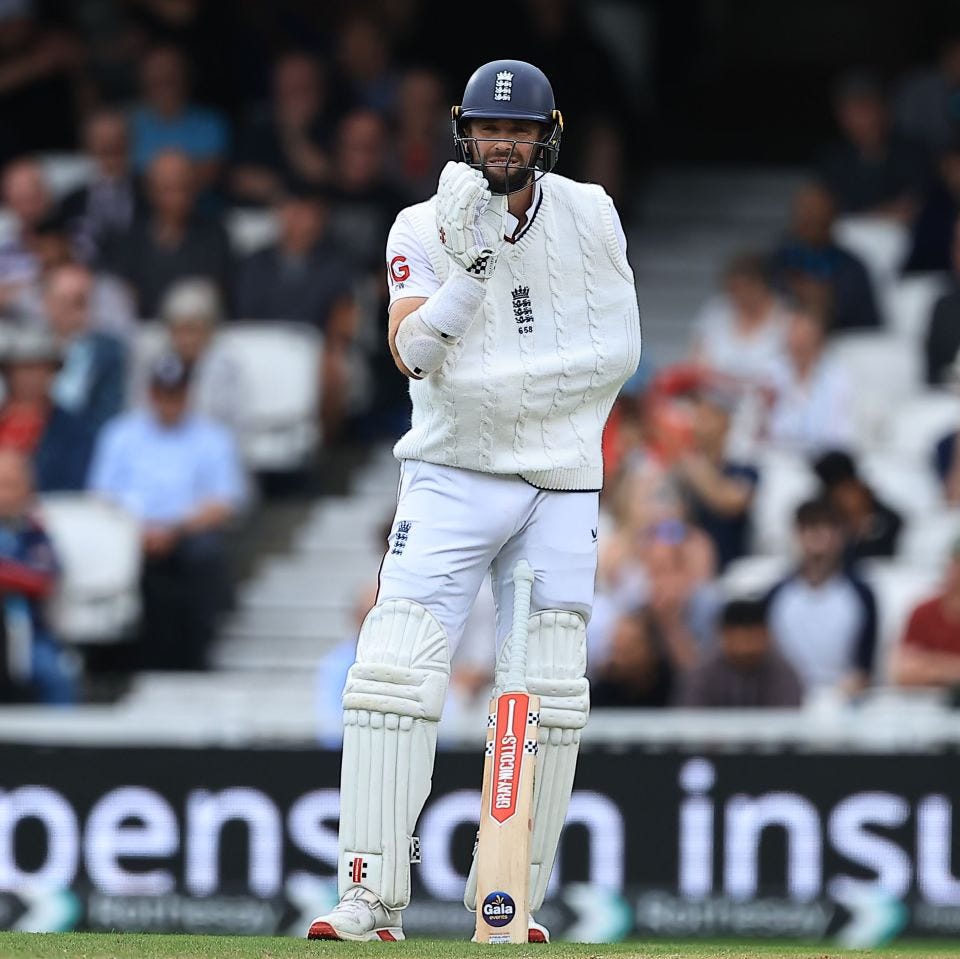
We were all left stunned on the final day of England’s Test series against India today as Chris Woakes walked out to bat one handed in a desperate bid to save the match. England began day five needing 35 runs to clinch victory and take the series, but a blistering spell from India’s bowlers saw three wickets fall in just over half an hour. With only one wicket remaining and 17 runs still required, Woakes (who had dislocated his shoulder on the opening day and had not played since) emerged from the pavilion with his arm in a sling.
Woakes grimaced through every movement as the last pair attempted to inch England towards an unlikely win. But the fairytale wasn’t to be, with Woakes stranded at the non striker’s end as his partner was dismissed, giving India the win and tying the series.
It was a moment that transcended the scoreline, an act of raw courage that left spectators (and myself) in awe. It was a wonderful example of sport’s incredible ability to reveal the limits we’re willing to push when everything is on the line.
What courage really is (and what it isn’t)
Courage is often misunderstood. We imagine it and often refer to it as fearlessness, a mystical absence of nerves. But that’s not what it is at all. Real courage is the decision to act despite fear and being afraid. It’s what psychologists call ‘approach motivation,’ the ability to run toward the burning building rather than away from it. Woakes was not fearless when he walked out to bat with his team staring down defeat and his shoulder strapped in a sling. He was fully aware of the pain, the risk of further injury, the likelihood of defeat. His body might have been telling him to retreat, but he moved forward anyway.
The brain in moments of bravery
When we step into high stakes situations like this, two parts of the brain wrestle for control. The amygdala, our internal alarm system, floods us with fear signals. There’s a pounding heart, shallow breath, and trembling muscles. The prefrontal cortex, the rational leader of the brain, works to override those alarms, focusing on meaning, purpose, and the bigger picture. In courageous moments, the prefrontal cortex essentially says, “yes, this is dangerous, but what we’re trying ti achieve matters more.” Research shows that courageous acts like Woakes’ rely on this delicate balance between fear and meaning. It’s not that fear vanishes or that it’s not there, it’s that meaning wins.
Why courage sets people apart
Most people’s lives are governed by a principle that psychologists call loss aversion, an unconscious bias to avoid risk and pain. It’s why many freeze in clutch moments. But the rare few who override this bias (the firefighters, medics, soldiers, and athletes) stand apart. Courage is powerful because it inspires. We feel something awaken in us when we witness it. Neuroscience suggests mirror neurons play a role, when we see someone step into danger for something bigger than themselves, our own brains light up as if we were the ones taking the risk. That’s why moments like Woakes’ one handed stand ripple far beyond the boundary rope. They provide us with a story about what’s possible in ourselves.
The Science behind building fearlessness
Fearlessness, or more accurately fear regulation doesn’t always just happen by accident or because of a moment unfolding in a game. It can be trained. Here are a couple of things that can help you train that muscle.
Exposure and adaptation. Repeatedly facing discomfort recalibrates the nervous system. Soldiers and elite athletes use this to normalise stress responses.
Purpose anchoring. Connecting to a deeper ‘why’ (team, country, legacy) shifts focus away from pain and toward meaning.
Breath and physiology control. Slow, deliberate breathing calms the vagus nerve and reduces the amygdala’s alarm bells, restoring clarity.
Visualisation. Rehearsing courageous acts in the mind primes neural pathways for real execution.
Walking into the storm
Woakes didn’t hit the winning runs in today’s game. In fact, he didn’t even face a single ball. But what made the moment so extraordinary was when his team’s need was greatest, with fear clawing at his insides and pain radiating through his shoulder, he walked out to bat. One handed, bandaged and broken, he walked into the storm.
Courage doesn’t always deliver victory. But it always provides us with meaning, inspiration, and the undeniable proof that we’re capable of far more than we believe. When we watched Chris Woakes walk to the crease this morning, we were watching the human spirit in motion, a beautiful example of how when fear is loud, bravery can be louder.