
The Belief Barrier
What happens when the impossible becomes inevitable

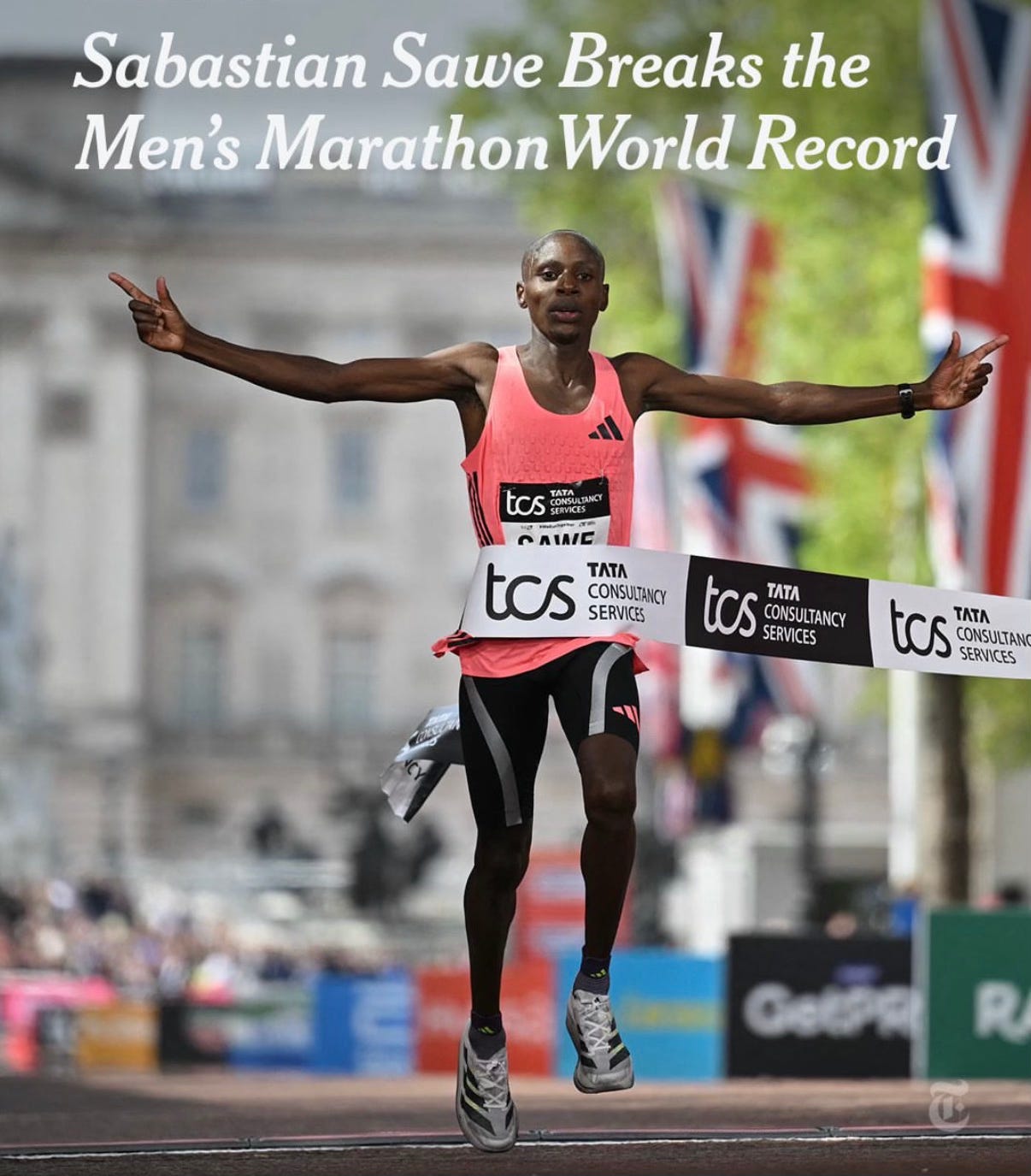
For decades, the sub two hour marathon felt like one of sport’s sacred impossibilities. Not difficult, but impossible. The human body we were told had limits. There was a wall somewhere around two hours, and beyond it lived fantasy. Experts made charts and physiologists drew ceilings and the number became mythology.
And then humans did what humans often do when presented with a ceiling. They stared at it long enough to realise it might not be a limit. Earlier today Sabastian Sawe ran the London Marathon in 1:59:30, becoming the first man to run a legal sub two hour marathon race. He didn’t run that time in a lab, it wasn’t a staged exhibition or a controlled environment. He ran it in the open theatre of competition, on a real course against the clock and history.
I haven’t been able to stop thinking about it, and how this achievement represents an incredible psychological earthquake.
Kipchoge and the first crack in the ceiling
Years ago, this would have sounded absurd. Then Eliud Kipchoge began moving the frontier. He ran with a serenity that made suffering look negotiable. He declared that no human is limited. He broke barriers officially, then chased two hours in an assisted exhibition, showing the world that the line was not sacred after all. A generation of runners watched and were inspired. Youngsters saw a man dare publicly at the edge of what was thought impossible. They saw him miss, adjust, persist and get closer. They saw possibility rehearsed in real time. That matters more than most people realise.
Why seeing it changes everything
Psychologist Albert Bandura spent decades studying what he called self efficacy, which loosely translates to belief in one’s own capacity to perform. His research showed that one of the most powerful ways to build self efficacy is through vicarious experience, watching someone like you achieve something you aspire to. The brain registers it as evidence. It’s almost like it says that this is possible, because I have seen it with my own eyes.
Belief as human infrastructure
Belief acts as a sort of infrastructure. It changes what the nervous system permits. It changes what effort feels worth investing in. It changes how pain is interpreted, how risk is framed, how long someone stays in the fight. When you believe something cannot be done, the brain often conserves. It protects and pulls you back early. When you believe something can be done, the brain allocates differently. It leans in and searches for solutions. It tolerates more discomfort because the discomfort now has meaning.
Roger Bannister and the floodgate effect
This is why the story of Roger Bannister still echoes. For years, the four minute mile was considered unreachable. Bannister broke it in 1954. Soon after, many others followed. What changed you might ask. The runners didn’t suddenly evolve. The physiology did not suddenly mutate in six weeks. Belief did. Training methods helped, but the seismic shift was psychological. The impossible had been made visible. The wall had been revealed as a story as opposed to a fact. And once people could see through the wall, they could run through it. What was once considered beyond the boundary of human biology is now almost routine in elite circles. A barrier that lives in the culture often lives in the body too. And when culture changes, bodies frequently follow. That is what makes Sawe’s run so significant. The 1:59:30 is now everyone’s new reference point.
The new sky
Every ambitious marathoner on earth now trains under a different sky. Some teenager in Kenya, Ethiopia, Japan, Britain, Jamaica or Australia has just seen the impossible become normal. Some coach will now design sessions with bolder assumptions. Some athlete will suffer through mile 22 one day and think that this pace belongs to human beings now. That thought may be worth minutes. Neuroscience has a language for some of this. Expectation shapes perception and confidence changes motor output. Dopamine rises when success feels plausible, increasing motivation and persistence.
The brain is a prediction machine
The human brain, for all its astonishing complexity, is fundamentally a prediction machine, and what it predicts influences what it allows. It is constantly running simulations of what is likely, what is safe and what is achievable. These simulations are shaped by experience, but crucially they are also shaped by what we have seen others do. The brain’s mirror neuron systems allow us to internalise the performances of others, to feel them in our own bodies, to update our internal models of what is possible.
When belief meets preparation
In simple terms, when the mind widens, performance often widens with it. That doesn’t mean belief alone wins races. Belief without work is fantasy. Belief without talent is theatre. Belief without training is a motivational poster in running shoes. But when belief meets discipline, science, repetition, courage, pain tolerance and proper preparation, what we’re capable of opens in new directions. Sawe said he believed he could break two hours. That matters because every great leap is born twice - first in the imagination, then in reality. Sunday was not only about the performance of one extraordinary man. It was about what happens when one person stretches the map for everyone else. And now the floodgates may open.
A relocated horizon changes everything. It changes how you train and how you think and what you dare to attempt. It changes the questions your mind is willing to ask. Instead of can it be done, it’s now how much faster can it be done? Instead of is this possible, it’s now what would it take?
Where the magic really begins
So what’s possible now? 1:58? 1:57? What seemed outrageous yesterday becomes a target tomorrow.
This is the beautiful lesson of sport, and perhaps of life. Many of the limits we inherit are estimates and false beliefs dressed as facts. Someone questions them, then suffers to test them, then proves otherwise. And then the rest of us must reconsider what else we have been calling impossible.
Belief might seem like magic, but sometimes it is just the beginning of it. What a privilege it was to witness this latest example.