
He Wasn't Chasing Mountains
Nims Purja and the cost of feeling alive

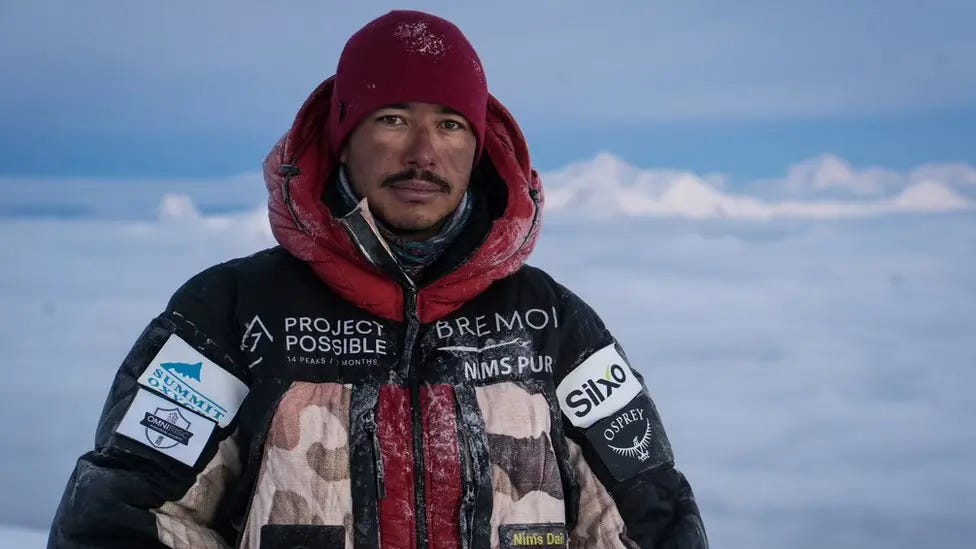
I haven’t been able to stop thinking about Nirmal Purja since I heard the terrible news last night. I watched 14 Peaks a while ago, the documentary chronicling his astonishing mission to climb all 14 of the world’s 8000 metre peaks in just six months, a feat many believed impossible, and sat there in complete awe. I was blown away by Nims’ courage, his almost unimaginable sense of adventure and the sheer audacity of what he was attempting. It’s tough to put into words, but there was something wonderfully outrageous about him. He seemed to have made peace with fear in a way most of us never will. He kept walking towards places that every instinct tells us to avoid, and somehow made the impossible look almost ordinary.
So when I read that Nims had been killed in an avalanche on Broad Peak in Pakistan, it genuinely floored me. And I don’t think it was because death in the mountains is unimaginable. Death is an accepted part of the bargain in high altitude mountaineering, every climber knows that and every expedition carries that possibility with it. What shocked me was something else entirely, and it’s a harder thing to explain. There comes a point with people like Nims, after they’ve defied the odds again and again, when you almost stop believing they’re subject to the same rules as everyone else. They survive storms that should have claimed them. They rescue others when self preservation would tell most of us to turn around. They repeatedly walk into places where the margin for error is measured in millimetres and seconds, and somehow keep coming back. They begin to feel almost mythological, as though the normal rules of mortality no longer quite apply to them. Until one day they do.
For all the incredible records he broke, I don’t think that is what people will remember most. Nims spent his life trying to convince us that our limits are rarely as fixed as we believe they are. By the way he chose to live and his refusal to accept what everyone else considered impossible, he invited millions of people to think bigger about their own lives. That more than any summit he ever stood upon feels like his real legacy.
Ever since I heard the news, I’ve found myself thinking about the same question that tragedies like this always seem to leave behind. Why? Why keep going back? Why wasn’t Everest enough? Or K2? Or all fourteen in six months? Or doing it all over again without oxygen? At what point does someone finally decide they’ve done enough? Most of us ask these questions because we instinctively imagine the calculation differently. We think in terms of risk. We picture the avalanche, the crevasse, the fall, the families left behind. We see danger first and wonder how anyone could willingly step towards it.
But I suspect people like Nims see something entirely different. They don’t spend their lives chasing death. They spend their lives chasing a way of being that most of us only experience by accident. I think Nims was trying to tell us exactly that in 14 peaks. You never get the sense that he is chasing records for the sake of records or mountains for the sake of mountains. He is chasing something far more difficult to describe. Again and again he speaks about purpose, about possibility and about feeling truly alive. At one point he reflects that death is certain for all of us once we are born, so why spend our lives shrinking from it? His responsibility, as he saw it, was to keep moving towards something bigger than himself.
Watching him I couldn’t help thinking that the mountains were almost incidental. They were simply where he found the deepest version of himself. Where the noise disappeared and there was no audience to impress, no reputation to protect, no past to regret or future to worry about. There was only the climb. I have heard remarkably similar things from a close friend of mine who has spent much of his life exploring the world’s wildest places. He once described standing high on a mountain and feeling the boundary between himself and the landscape dissolve completely. He spoke about an overwhelming sense of love, purpose and connection, of being exactly where he was meant to be. Then he smiled and said something I’ll never forget. “There is no other drug quite like it in the world.”
Alex Honnold has spoken about it like this too (the same climber incidentally who free soloed El Capitan without a rope back in 2017 and more recently climbed Taipei 101 without so much as a harness). People constantly ask why he would risk everything. His answer is so simple. He says nothing else compares to how it feels when he is climbing. That is where he feels most alive. What is that feeling? What is it about certain moments that can make life feel so vivid and so complete that people willingly organise their entire lives around returning to them?
The great Hungarian psychologist Mihaly Csikszentmihalyi spent decades trying to answer exactly that question. But instead of studying happiness in the ordinary sense, he wanted to understand what human beings experienced in the moments when they felt most completely alive. So he went looking. He interviewed artists and surgeons, dancers and chess masters, musicians, athletes, scientists, farmers and factory workers. People whose lives looked nothing alike. He wasn’t searching for successful people or famous people, he was searching for people who became utterly absorbed in what they were doing.
What he discovered surprised him. Despite their wildly different lives, they all described almost exactly the same experience. They spoke of attention becoming so complete that the rest of the world just disappeared. Time seemed to slow, or vanish altogether. Self consciousness melted away. They no longer felt separate from what they were doing. The activity itself became so deeply rewarding that there was nowhere else they would rather have been. The reward wasn’t waiting at the end, it was hidden inside the doing itself. Eventually, Csikszentmihalyi gave that magical state a name. Flow.
It is one of the most extraordinary discoveries in modern psychology. A state in which we don’t simply perform at our best, but feel at our best. A state so intrinsically rewarding that people willingly organise their lives around returning to it, sometimes sacrificing comfort, security, status and certainty just for another chance to experience it. I think flow helps explain something many of us misunderstand about people like Nims. From the outside, it looks as though they are addicted to danger. From the inside, I suspect they are addicted to living in the moment.
One of the strongest triggers of flow is consequence. When the stakes become genuinely meaningful, your brain can no longer afford distraction. There is no room for emails, regrets, politics or yesterday’s mistakes. There is only the next breath, the next movement, the next decision. Real risk strips reality back to its essentials. That is why Alex Honnold looks almost peaceful halfway up a sheer rock face. That is why elite athletes often describe competition as weirdly calm despite performing under extreme pressure. Their minds have become completely organised around the present moment.
Most of us rarely experience attention like that. We live splintered lives, half listening and half worrying, half somewhere else. People like Nims don’t experience that luxury on an 8000 metre peak. The mountain demands everything. And in demanding everything, it gives something phenomenal back. It gives them a mind with nowhere else to be. Of course, none of this means these people have a death wish. Quite the opposite. Before setting off for Broad Peak, Nims wrote something that now feels unbearably poignant.
“Broad Peak, I ask for nothing but safe passage up and back down. I take zero mountains for granted.”
He knew exactly what the mountain was capable of. He had spent years rescuing climbers, watching friends die and surviving situations most of us cannot begin to imagine. This was a conscious choice rather than recklessness or ignorance. Every meaningful life involves a bargain. Some people exchange aliveness for more certainty. Others make the exchange the other way round. Neither bargain comes free. One costs possibility, the other costs safety. Nims understood the bargain he had made.
There is an irony worth pointing out here. Most of us spend our lives trying to make everything safer. Safer careers and conversations, safer relationships and safer dreams. We build contingency upon contingency until eventually we mistake the absence of danger for the presence of life. But they are not the same thing. Nims didn’t climb mountains chasing death. He climbed them chasing a version of himself that didn’t exist anywhere else, one that only surfaced when complete commitment met immense consequence. A version free from noise and ego, a version free from hesitation and entirely himself.
Maybe that is why mystics, artists and adventurers so often end up describing similar experiences despite travelling such different roads. Whether through meditation, music, painting, prayer or climbing, they all seem to stumble upon the same place. A place where the self briefly falls away and there is nothing left except pure participation in reality. Maybe that is what transcendence looks like. Maybe that’s what it has always been.
Nims Purja died doing the thing that made him feel most completely alive. There is something deeply uncomfortable about writing that sentence. It should be uncomfortable, because it forces us to ask a much harder question than whether climbing mountains is worth the risk. It asks whether we ourselves are truly alive. For all the impossible summits he climbed, I don’t think that was ever the real mountain.
Most of us will never stand beneath the towering walls of Broad Peak. We will never feel the thin air of the Karakoram or watch the sun rise above 8000 metres. But all of us have our own mountains. Our own edges and places where comfort goes and possibility begins. Nims spent his life showing us that human beings are capable of far more than we imagine. He did so much more than just climb impossible mountains, he refused to accept the limitations that most of us place on ourselves long before life ever does. He also showed us what it looks like when a person finally stops negotiating with their own life, when they walk toward the thing that makes them feel most real, and keep walking, cost be damned.
Maybe that is the greatest gift he leaves behind. By every measure that truly matters, he showed us what it looks like to be gloriously, courageously and impossibly alive. And in the end, the mountain didn’t take that from him. It was just the last place he went looking for it.
So true, Hassan. I fully agree.
But this whole story and your explanation give one more important realization: most of us merely lives our lives. We live like we are waiting already for death to come, whenever it happens. This is very sad and very confronting. But it is all in our hands how we want to deal with this.
Thank you for your gentle reminder.
I was thinking about this same question since yesterday after hearing the news. I have somehow stumbled upon your insta post for the same. I just couldn't wait and installed Substack this morning for the very first time just to listen it. Why do people go this far again and again. I believe somewhere I have received the Answer. Limits are only there in our mind, once we break them we are going to move towards the flow state and experience the highest form of truly being alive.
True legends never die. 🏔️
You have beautifully captured it ❤️
Thank you for writing it. Keep doing the great work. 👍