

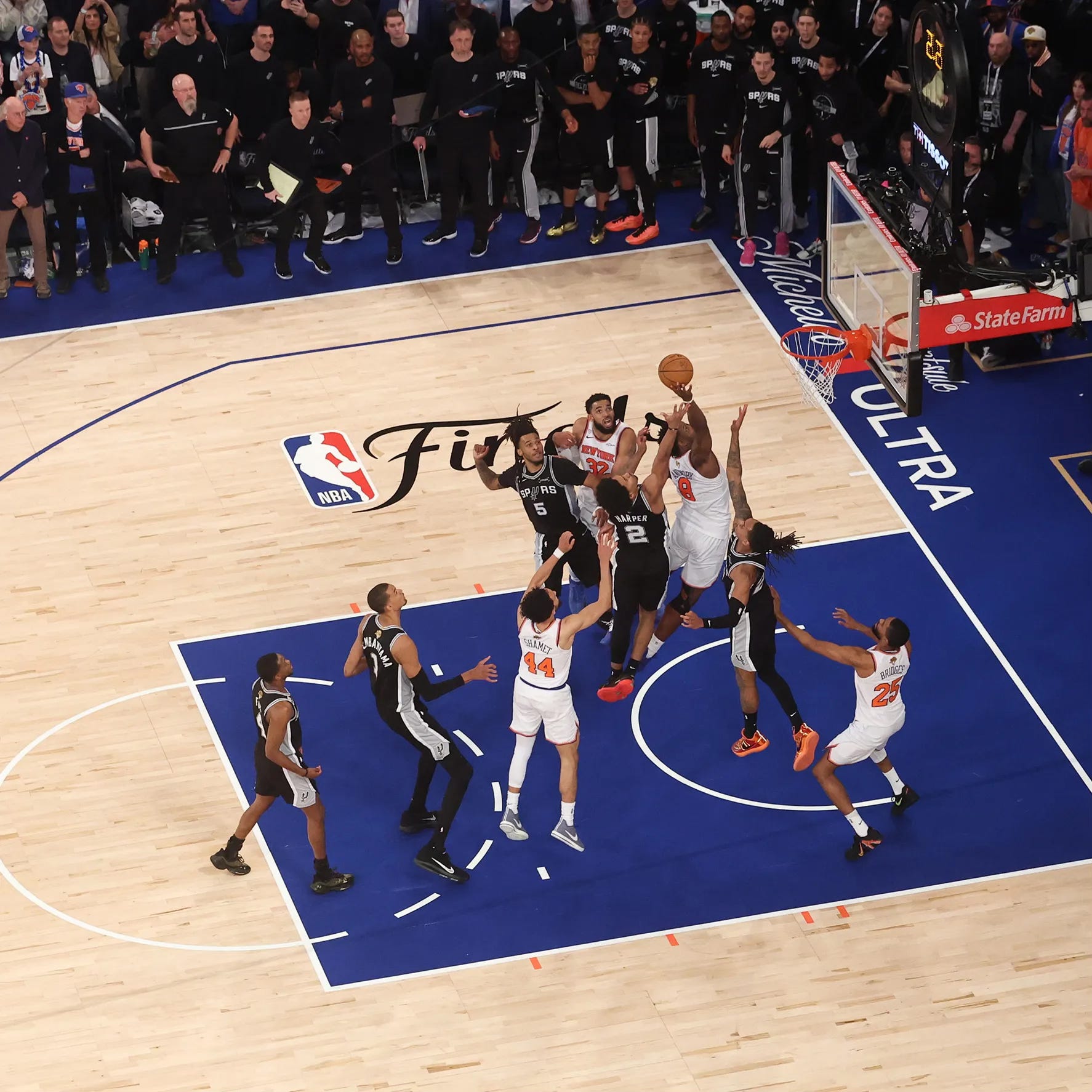
With ten minutes remaining in Game 4 of the NBA Finals, the New York Knicks had a 2% chance of winning. The Spurs were leading by 18 and had earlier built a 29 point advantage, the largest deficit ever overcome in an NBA Finals game. The crowd had gone from hopeful to frustrated. Some fans had booed at halftime. San Antonio couldn’t miss, and New York looked exhausted, overwhelmed and beaten. If you were looking at the scoreboard, the statistics, the probabilities and every available piece of evidence, the conclusion seemed obvious. The game was over. And yet somehow, it wasn’t. The Knicks ended up completing the greatest comeback in NBA finals history.
And I haven’t been able to stop thinking about it. Sooner or later all of us find ourselves staring at some version of an 18 deficit with ten minutes left. A business that appears to be failing. A relationship hanging by a thread. A dream that feels increasingly distant. A setback that has knocked the wind from our lungs. A season of life where the gap between where we are and where we want to be feels impossibly large. The question I haven’t been able to stop thinking about is how human beings continue believing something when everything in front of them suggests they shouldn’t.
The real test of belief
Most people misunderstand belief. They think belief is what happens when success feels likely. But that’s not belief at all. That’s prediction. Belief only becomes belief when doubt enters the room. When the odds turn against you and the scoreboard looks ugly, when logic begins building a compelling case for surrender. Anybody can believe when they’re winning. Anybody can feel confident when momentum is on their side and things are unfolding exactly as planned. The true test comes when they aren’t.
When certainty disappears
This is what made the Knicks’ comeback so extraordinary. Not the points they recovered, but the mindset they maintained. The players on that court were not delusional. They could see the scoreboard. They understood the situation. They knew exactly how difficult their task had become. Yet they continued acting as though the game was still alive. That ability might be one of the most important psychological skills a human being can develop. The capacity to hold onto possibility long after certainty has disappeared.
Hope beyond logic
What fascinates me most is that history is filled with people who found themselves in similar situations. Different arenas and different circumstances, but the same underlying challenge. How do you keep moving when success no longer appears likely? The answer I think is hope. Not optimism, but hope. Optimism says everything will work out, hope says I will continue anyway. Optimism is often built on favourable circumstances, hope survives despite unfavourable ones. It is the force that allows a mountaineer to take another step when they can no longer see the summit. It is what carries entrepreneurs through years of rejection. It is what helps people endure grief, illness, heartbreak and uncertainty. Hope is not the belief that things will definitely improve. It is the refusal to stop because they haven’t improved yet. The Knicks didn’t know they were going to win. Nobody did. What they knew was that the game wasn’t over. And sometimes that is enough.
The secret of every comeback
Jalen Brunson explained it perfectly afterwards. When they were down 29, they weren’t thinking about winning the game. They were thinking about getting the deficit to 20. Then 18. Then 10. Then 6. Then one possession. This is one of the great secrets of resilience. Human beings rarely fail because a challenge is too large. More often, we fail because we become overwhelmed by its size. We stare at the entire mountain and convince ourselves we cannot climb it. We look at the distance remaining and lose the ability to take the next step. The people who achieve extraordinary things tend to approach adversity differently. They don’t focus on the whole journey. They focus on the next foothold. The next breath or conversation, the next play. The Knicks never overcame 29 points. They overcame one possession. Then another, and another, and another. And eventually the impossible began to look different.
The psychology of possibility
There is a reason belief matters so much. Belief changes behaviour. When we believe something remains possible, we continue to act. We continue searching for solutions and continue adapting. We continue putting ourselves in positions where opportunities can emerge. Psychologists have demonstrated this repeatedly. Belief affects persistence. It affects resilience and effort. It influences how long we stay in the fight when circumstances become difficult. Belief does not magically change reality, but it changes us. And when we change, reality often changes with us. The Knicks didn’t erase a 29 point deficit because they convinced themselves they were already winning. They erased it because they refused to behave like a team that had already lost. That distinction matters. Belief isn’t pretending, it’s persisting.
The power of maybe
There is a beautiful word hidden inside every remarkable comeback. Maybe. Maybe there is still time or maybe there is still a way. Maybe the story isn’t finished. Maybe this isn’t the end. Human progress has always belonged to people who were willing to live inside that word. Roger Bannister looked at the fourminute mile and said maybe. Countless explorers, inventors, entrepreneurs, artists and dreamers have stared at situations that appeared impossible and said the same thing. Possibility often begins as nothing more than a refusal to completely close the door.
The scoreboard is not a verdict
Maybe that is the lesson hidden inside what happened at Madison Square Garden. The scoreboard is not a verdict. It tells you where you are, it doesn’t tell you where you can go. Somewhere out there, someone reading this is staring at their own scoreboard. A challenge that feels overwhelming or a dream that feels too distant, a gap that feels too large, a situation that appears unwinnable. Maybe it is. Maybe it isn’t.
But the Knicks showed us that you do not need certainty to continue. You only need possibility. You only need enough hope to take the next step. And sometimes, remarkably, that is enough to change everything. The scoreboard can tell you where you are. But it can’t tell you what happens next. And that is beautiful.
I really enjoyed this article. I work as a Coach in a 6th form College and everything you wrote here resonates with what can happen in the last few weeks and days of term. The analogy of the scoreboard is powerful. Thankyou.
I am not a super knicks or spurs fan but have enjoyed watching some games in this series. I admit I was not excited watching the last few minutes of this game (with all the celebrity camera flashes court side) but this article is beautiful and excellent perspective. Thank you for providing another hope- filled frame for this game and life.